The councillors
Joseph & Nicodemus
Both in Scripture · Private lives imagined
Witness IV of VI · Night indigo
02 In one line
Two rich, careful men who found their nerve at the exact moment it could no longer do any good — and became the witnesses nobody could argue with.
03 In the books
Joseph built a life on discretion. Sixty years of never saying the wrong thing at the wrong time; of the grave nod that commits to nothing; of doing a great deal of harm without ever once doing anything wrong. He owned a new tomb, cut for his own bones. His wife Tirzah loves him without a single illusion, and is the one voice he cannot manage — the small worn place where his conscience used to be louder.
Nicodemus built a life on answers. The teacher of Israel: the man who could untie any knot the Law could tie, whose whole creed was that everything has a latch for a patient enough mind. Then something knocked that would not fit through the door of the soluble. The great solver came by night, carrying a question no learning could untie — and was told about a wind that blows where it wishes, and went home none the wiser and entirely changed, with a sentence in him he could neither solve nor set down.
Both had sat silent in the chamber when a word might have mattered. Neither consented; neither stood. Both find their courage only when it can accomplish nothing at all except honour — asking a Roman governor for a condemned man’s body, arriving bowed under a king’s weight of myrrh and aloes, and laying the body in the rich man’s own new tomb, in daylight, in the open, where anybody could see them do it.
04 In Scripture
Joseph of Arimathea — a rich member of the council who had not consented to their decision; he asks Pilate for the body and lays it in his own new tomb. Matthew 27:57–60; Mark 15:43–46; Luke 23:50–53; John 19:38.
Nicodemus — a Pharisee and ruler of the Jews who comes to Jesus by night. John 3:1–21. He argues for due process in the council. John 7:50–52. He brings about a hundred pounds of myrrh and aloes to the burial. John 19:39.
Tirzah, the student Yonatan, and the whole interior life of both men are original.
Matthew 27:57–60
57When evening had come, a rich man from Arimathaea, named Joseph, who himself was also Jesus’ disciple came. 58This man went to Pilate, and asked for Jesus’ body. Then Pilate commanded the body to be given up. 59Joseph took the body, and wrapped it in a clean linen cloth, 60and laid it in his own new tomb, which he had cut out in the rock, and he rolled a great stone against the door of the tomb, and departed.
Mark 15:43–46
43Joseph of Arimathaea, a prominent council member who also himself was looking for God’s Kingdom, came. He boldly went in to Pilate, and asked for Jesus’ body. 44Pilate marveled if he were already dead; and summoning the centurion, he asked him whether he had been dead long. 45When he found out from the centurion, he granted the body to Joseph. 46He bought a linen cloth, and taking him down, wound him in the linen cloth, and laid him in a tomb which had been cut out of a rock. He rolled a stone against the door of the tomb.
Luke 23:50–53
50Behold, a man named Joseph, who was a member of the council, a good and righteous man 51(he had not consented to their counsel and deed), from Arimathaea, a city of the Jews, who was also waiting for God’s Kingdom: 52this man went to Pilate, and asked for Jesus’ body. 53He took it down, and wrapped it in a linen cloth, and laid him in a tomb that was cut in stone, where no one had ever been laid.
John 19:38–42
38After these things, Joseph of Arimathaea, being a disciple of Jesus, but secretly for fear of the Jews, asked of Pilate that he might take away Jesus’ body. Pilate gave him permission. He came therefore and took away his body. 39Nicodemus, who at first came to Jesus by night, also came bringing a mixture of myrrh and aloes, about a hundred Roman pounds. 40So they took Jesus’ body, and bound it in linen cloths with the spices, as the custom of the Jews is to bury. 41Now in the place where he was crucified there was a garden. In the garden was a new tomb in which no man had ever yet been laid. 42Then because of the Jews’ Preparation Day (for the tomb was near at hand) they laid Jesus there.
John 3:1–21
1Now there was a man of the Pharisees named Nicodemus, a ruler of the Jews. 2The same came to him by night, and said to him, “Rabbi, we know that you are a teacher come from God, for no one can do these signs that you do, unless God is with him.” 3Jesus answered him, “Most certainly, I tell you, unless one is born anew, he can’t see God’s Kingdom.” 4Nicodemus said to him, “How can a man be born when he is old? Can he enter a second time into his mother’s womb, and be born?” 5Jesus answered, “Most certainly I tell you, unless one is born of water and spirit, he can’t enter into God’s Kingdom. 6That which is born of the flesh is flesh. That which is born of the Spirit is spirit. 7Don’t marvel that I said to you, ‘You must be born anew.’ 8The wind blows where it wants to, and you hear its sound, but don’t know where it comes from and where it is going. So is everyone who is born of the Spirit.” 9Nicodemus answered him, “How can these things be?” 10Jesus answered him, “Are you the teacher of Israel, and don’t understand these things? 11Most certainly I tell you, we speak that which we know, and testify of that which we have seen, and you don’t receive our witness. 12If I told you earthly things and you don’t believe, how will you believe if I tell you heavenly things? 13No one has ascended into heaven, but he who descended out of heaven, the Son of Man, who is in heaven. 14As Moses lifted up the serpent in the wilderness, even so must the Son of Man be lifted up, 15that whoever believes in him should not perish, but have eternal life. 16For God so loved the world, that he gave his one and only Son, that whoever believes in him should not perish, but have eternal life. 17For God didn’t send his Son into the world to judge the world, but that the world should be saved through him. 18He who believes in him is not judged. He who doesn’t believe has been judged already, because he has not believed in the name of the one and only Son of God. 19This is the judgment, that the light has come into the world, and men loved the darkness rather than the light; for their works were evil. 20For everyone who does evil hates the light, and doesn’t come to the light, lest his works would be exposed. 21But he who does the truth comes to the light, that his works may be revealed, that they have been done in God.”
John 7:50–52
50Nicodemus (he who came to him by night, being one of them) said to them, 51“Does our law judge a man, unless it first hears from him personally and knows what he does?” 52They answered him, “Are you also from Galilee? Search, and see that no prophet has arisen out of Galilee.”
05 Their world
The Sanhedrin: seventy-one men judging the life of a nation under Rome’s watchful boredom, where speech was the dangerous currency and the safest man in the room was the one never quite on anyone’s side.
06 What they carry
That courage delayed is still courage — and that the very lateness of theirs is what made them unanswerable. Two respectable men with every reason in the world to stay hidden are the ones who handled the body, washed it, wrapped it and sealed it in. They can swear it was truly, finally dead. The empty tomb is their tomb.
07 A lesson
Playing it safe has a cost that never appears on any ledger — a whole life of small silences, and the slow discovery that the gap between dissent and silence is thinner than you thought. I kept my courage hidden so long that I nearly let it die unused. Nearly. The word is a small one, and it holds a whole salvation.
08 Threads
They stand at a careful distance on the hill while Demas dies and Aziz does his work. It is Joseph’s borrowed grave that Mary finds empty three mornings later. Both appear again at Miriam’s table in Book VI, openly among the believers, their earlier caution finally spent.
- Demas — Watched him dieGolgotha · The Councillors
- Longinus — Watched him do his workGolgotha · The Councillors
- Mary of Magdala — Their tomb, her morningThe borrowed tomb · The Women at the Tomb
- Miriam — At her tableThe lower city · The Gathering
09 Where they stood
10 Hear the opening
11 Their book
The Councillors (Book IV)
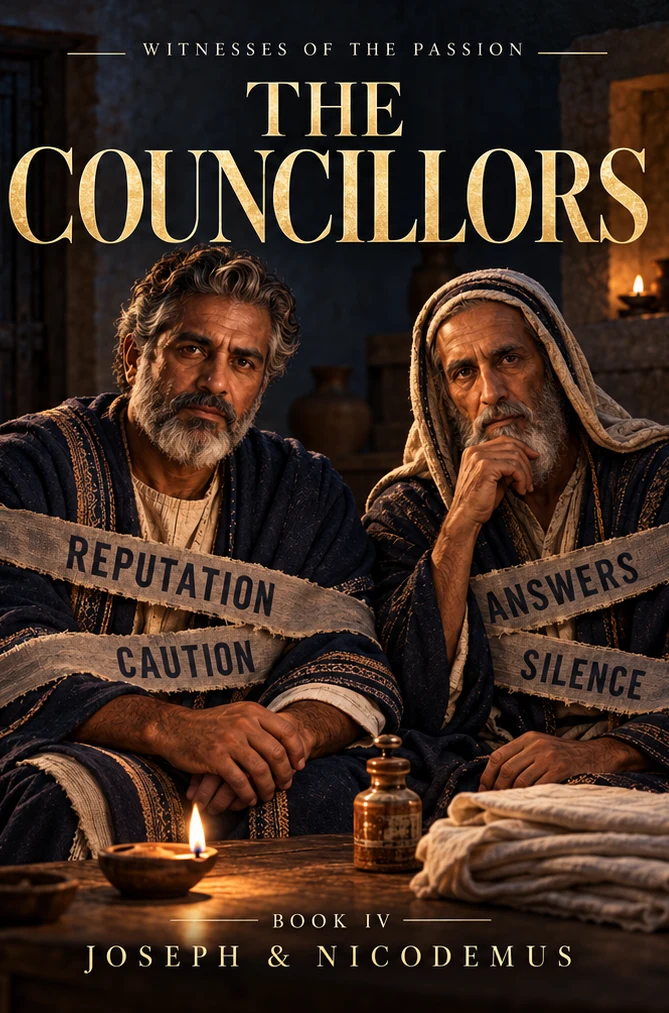
Book Four
The Councillors
Two careful men whose courage arrived too late to be safe.
Ebook · Paperback · Hardcover — From £4.99 (sample)
Which is harder to believe — that grace would reach the worst person you can think of, or that it would then seat you at the same table as them?