The widow who kept the door
Miriam
Original to the series
Witness VI of VI · Warm terracotta
02 In one line
The widow who kept the lamp lit and the door open for thirty years, and around whose table the whole scattered family finally gathered.
03 In the books
A carpenter’s widow from the northern hills. She was married briefly and happily to Eliezer — a big, gentle man who gave back the change, hung his own door and left it a hand’s breadth open onto the road, and carved a pomegranate into the lintel because there’s more inside than shows. He died before their son could remember his voice.
She raised the boy Judah alone through every kind of thinning, and blessed him nightly with the words her own mother had laid over her in the dark. When he took a borrowed name and vanished south into a hard life, she went on standing at the mouth of the road he had not taken, calling his true name down the road he had, into a silence that mostly did not answer. She knew a mother’s voice was a thin rope to throw across a widening gap. She threw it anyway.
She comes up to Jerusalem for one last feast, and stands on a hill to watch her son die with a promise in his ears. Grief cuts her loose from the old house; the resurrection ties her to a new one. She takes two rooms in the lower city, carves a second, lopsided pomegranate on the new lintel with a borrowed knife, keeps a lamp lit and a door open — and around that door gathers the great strange family the whole series has been assembling: a Roman soldier, a murderer, a healed woman, two rich councillors, and anyone else who comes up the road hungry.
04 In Scripture
Nothing directly. The penitent thief’s mother is never mentioned in the Gospels — Scripture gives him no name, no family and no history. Miriam is wholly imagined.
But the blessing she carries is real, and older than the story: the Aaronic blessing of Numbers 6:24–26
The Lord bless you and keep you. The Lord make his face shine upon you, and be gracious to you. The Lord lift up his countenance upon you, and give you peace.
The house-church she keeps is imagined, but the thing it stands for is historical: the early believers met in private houses and held everything in common. Acts 1:13; 2:44–47; 4:32–35.
Numbers 6:24–26
24‘Yahweh bless you, and keep you. 25Yahweh make his face to shine on you, and be gracious to you. 26Yahweh lift up his face toward you, and give you peace.’
Acts 1:13
13When they had come in, they went up into the upper room, where they were staying; that is Peter, John, James, Andrew, Philip, Thomas, Bartholomew, Matthew, James the son of Alphaeus, Simon the Zealot, and Judas the son of James.
Acts 4:32–35
32The multitude of those who believed were of one heart and soul. Not one of them claimed that anything of the things which he possessed was his own, but they had all things in common. 33With great power, the apostles gave their testimony of the resurrection of the Lord Jesus. Great grace was on them all. 34For neither was there among them any who lacked, for as many as were owners of lands or houses sold them, and brought the proceeds of the things that were sold, 35and laid them at the apostles’ feet, and distribution was made to each, according as anyone had need.
05 Her world
A village widow with one son and no man lived on the edge of everything: on alms, on neighbours, and on her own two hands, with no legal standing and no protection. Later, the crowded and dangerous lower city of Jerusalem, where a poor woman’s door left open at night was not hospitality but quiet defiance.
06 What she carries
She is the thread and the hearth of the whole series — the blessing, the door, the kept place at the table. If the other five books are about being reached by grace, Miriam’s is about what grace builds: a home for everyone it reaches.
07 A lesson
Faithfulness often looks like nothing more than keeping the lamp lit and the door open long after you have stopped being able to see why. The prayer said into apparent silence is not wasted. It may be answered thirty years later, on a hill, by someone else’s voice.
08 Threads
Wife of Eliezer, who carved the first pomegranate. Mother of Judah, who became Demas. Hers is the door Bar-Abba is finally carried to, a year after his release. At her deathbed she calls the stiff old soldier Aziz close, and blesses him, and Mary, and Barabbas, and the whole gathered church, each one by name.
- Demas — Her son, JudahThe house on the road · Remember Me
- Bar-Abba — Carried to her doorThe lower city · The Gathering
- Longinus — Blessed at her deathbedThe last door · The Gathering
- Mary of Magdala — Tends her at the endThe last door · The Gathering
- Joseph & Nicodemus — At her tableThe lower city · The Gathering
09 Where they stood
10 Hear the opening
11 Her book
The Gathering (Book VI) · She also opens the prequel, The Open Door, and Book I.
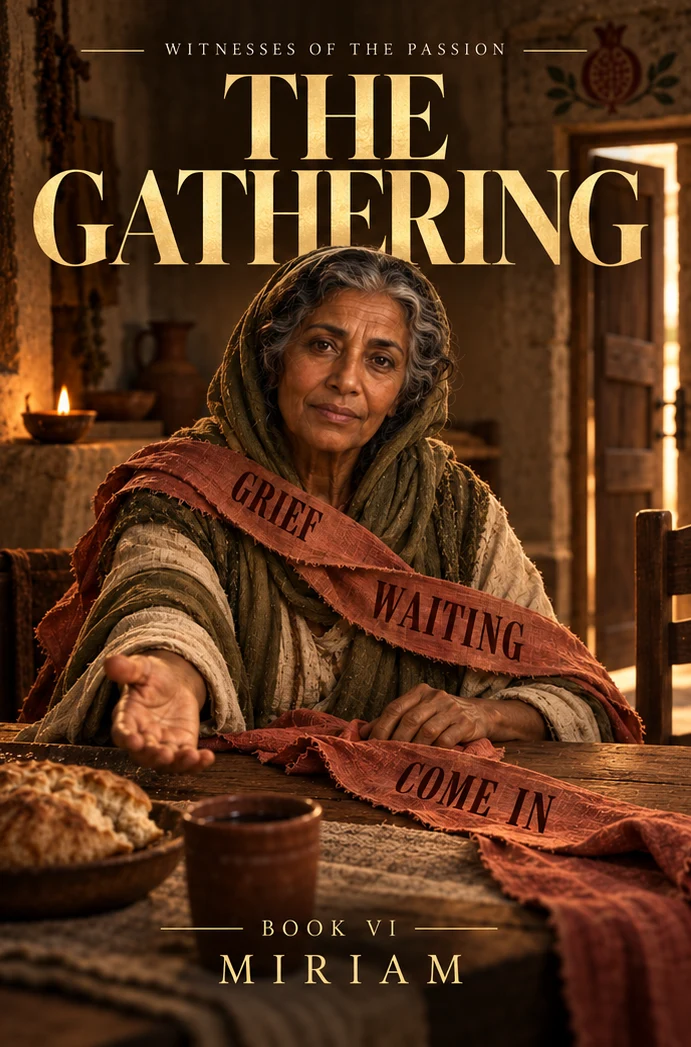
Book Six
The Gathering
The widow who kept the lamp lit for thirty years.
Ebook · Paperback · Hardcover — From £4.99 (sample)
Which is harder to believe — that grace would reach the worst person you can think of, or that it would then seat you at the same table as them?